
Why Do Our Ears and Noses Look Bigger as We Age?
The appearance of ears and noses changes as we age. This article explores changes in facial shape, skin and cartilage, and why understanding individual anatomy matters when making a facial prosthesis.
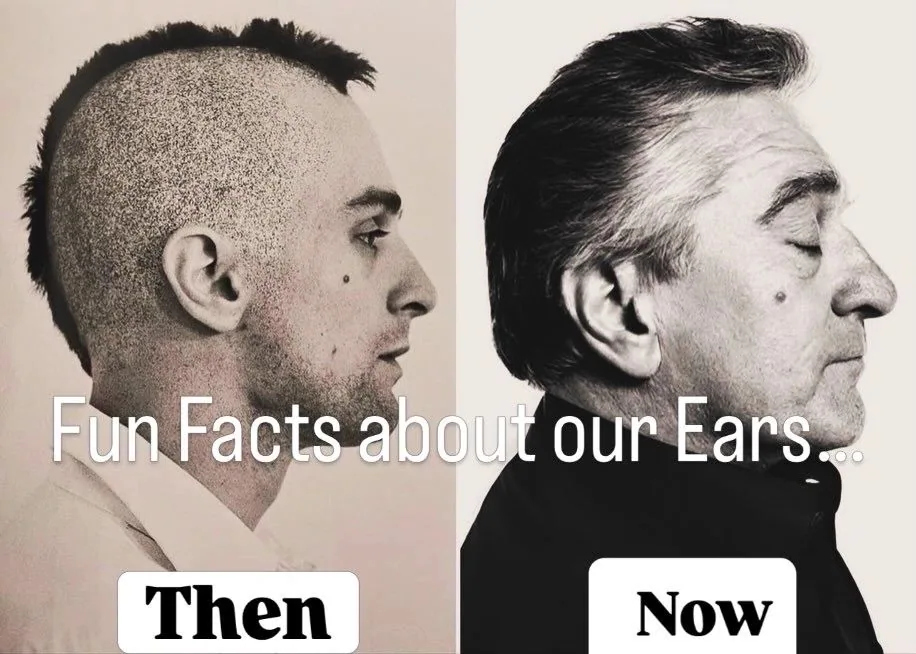
What Robert De Niro Can Teach Us
If you’ve ever looked at old photos of yourself and thought, “Wait… were my ears always that small?” — you’re not alone.
A great example of how the human face evolves over time is none other than Robert De Niro. Compare photos of him in his early career to today, and you might notice something interesting: his ears and nose appear more prominent. Before anyone panics about their mirror betraying them, don’t worry. This is a completely natural part of aging and happens to everyone.
Let’s unpack the science behind it.
Do Ears and Noses Actually Grow?
Yes… but also no.
They don’t grow the same way bones do during childhood. However, they do change over time, and the difference becomes noticeable across decades.
Scientific studies (including research published in the British Medical Journal) have shown that the average human ear length increases by about 0.22 millimetres per year, particularly after the age of 30. That might sound tiny, but over 30–40 years it adds up.
Another study found that ear circumference can increase by up to 0.5 millimetres per year. Over time, this gradual change can make ears look larger compared with younger photographs.
Blame Cartilage, Gravity… and Time
The key reason lies in cartilage, the flexible tissue that shapes both the ears and nose.
Unlike bone, cartilage does not fully harden. It remains flexible throughout life, which makes it more vulnerable to the effects of ageing. Over time:
* Collagen and elastin fibres break down
* Cartilage becomes less firm
* Skin loses elasticity
* Gravity does what gravity always does.
The result? Ears and noses may appear longer or more prominent as tissues slowly relax and stretch. Earlobes in particular are susceptible to this effect, which explains why they often elongate with age.
But Wait… There’s More...
Another interesting factor is bone density. As we age, the bones in the skull, like the rest of the body, can lose density and become thinner. This subtle structural change can make soft tissues appear more prominent, enhancing the illusion that the ears and nose are growing dramatically. So in many cases, the change is not only about cartilage and skin, but also about how the surrounding facial structure evolves over time.
Do Men and Women Age the Same Way?
Both men and women experience these changes. However, the rate can differ slightly, and hormonal and structural differences in facial tissues can influence how noticeable the changes become.
In general, men often show slightly more pronounced changes in ear and nose size over time, though the process affects everyone.
Why This Matters in Maxillofacial Prosthetics
This natural facial evolution becomes especially important in maxillofacial prosthetics. When patients require a prosthetic ear or prosthetic nose, clinicians are often asked to recreate the missing structure using old photographs, sometimes from decades earlier. And here’s the tricky part. The reference photo may show the patient in their 30s or 40s, while the prosthesis is being created when they are 50, 60, or much older. That means the prosthetist must consider:
* Natural aging changes
* Skin and cartilage relaxation
* Proportional facial changes over time.
Reconstructing a feature that looks natural today, while based on a younger face, is a fascinating blend of science, artistry, and anatomical understanding. In other words, it’s a bit like forensic reconstruction, with a touch of detective work.
Final Thoughts
Your ears and nose changing over time isn’t a flaw. It’s simply biology doing its thing. Our bodies continue to evolve throughout life, even in subtle ways we don’t always notice until we compare photos decades apart. So the next time you see an old picture and think your ears have grown a little more “distinguished,” remember:
It’s not just you.
It’s everyone.
Even Robert De Niro.
FAQ: Everything you Need to Know About Ears and Ageing
Q. Do human ears actually grow as we age? A. Yes. Ears gradually lengthen over time due to changes in cartilage, skin elasticity, and gravity, even though bone growth stops in adulthood.
Q. Why do some people’s ears look bigger than others as they get older? A. Factors include genetics, cartilage thickness, skin elasticity, and natural tissue relaxation, which can make ears appear more prominent with age.
Q. Can prosthetic ears look natural? A. Absolutely. Modern maxillofacial prosthetics use advanced materials and colour-matching techniques to create highly realistic ears that blend with your facial features.
Q. How long does a prosthetic ear last? A. With proper care, prosthetic ears can last 1–3 years, depending on the materials used, daily wear, and exposure to sunlight or moisture.
Q. Can a prosthetic ear be attached permanently? A. Prosthetic ears are usually removable, but in some cases, implants can be used to anchor a prosthesis more securely to the skull.
Q. Do women’s ears change as much as men’s with age? A. Yes, but typically at a slightly slower rate. Hormonal and structural differences can make changes in ear size and shape more subtle in women.
Q. Can prosthetic ears be made to match childhood photos? A. Yes, but it is challenging. Maxillofacial prosthetists must account for natural aging changes in skin, cartilage, and facial structure to make the prosthesis look natural today.
Q. Is it possible to improve hearing by wearing a larger prosthetic ear? A. No. Prosthetic ears are cosmetic; hearing depends on the inner ear and auditory nerves. A prosthetic cannot enhance hearing.
Q. How is a prosthetic ear made? A. The process involves taking a detailed impression, sculpting the ear in wax, casting it in silicone, and carefully painting it to match the patient’s skin tone and texture.
Q. Can prosthetic ears be customised for trauma, congenital differences, or cancer recovery? A. Yes. Maxillofacial prosthetics are highly personalised to restore appearance and symmetry for patients who have lost part or all of their ear due to injury, congenital conditions, or surgical removal.
Here to Help
At Engreco Healthcare, we combine over 19 years of clinical and technical expertise with a deep sense of empathy for every patient’s journey. Our mission is simple: To restore normality and dignity after life-changing surgery through compassionate prosthetic care.
If you are a surgeon, clinician, or trainee seeking to learn more about reconstructive plates and/or maxillofacial rehabilitation, our team is always happy to collaborate, educate, and support.
Contact us on www.engreco.co.uk.
Written by:
Anna Veli - Consultant Maxillofacial Prosthetist (Engreco Healthcare)
(05 February 2026)